



THE UNIVERSE IS NOT WHAT IT SEEMS
Exploring Quantum Reality, Time, Consciousness & the Nature of Existence
Join Research Circle →2.18K+
Subscribers
45+
Videos
35+
Shorts
201K+
Views
What This Platform Explores
Trending Videos
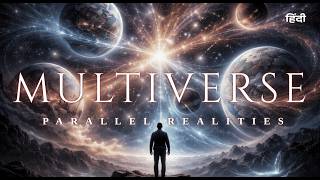
The Multiverse Theory You Were Never Told About
In this episode, we uncover the deepest structure of existence — the layered architecture of reality, the higher-dimensional Lokas described in ancient texts, the modern physics behind the multiverse, branching timelines, karma loops, and the invisible system connecting all outcomes. From quantum experiments to cosmic anomalies, from ancient revelations to modern science, Episode 1.3 reveals how: Reality is not one world, but many layers Timelines branch with every choice Higher dimensions influence the lower planes Consciousness connects realms Future insights come through rare “windows of awareness” And we are not just living inside the universe… the universe is expressing itself through us This chapter connects ancient wisdom and modern physics into one complete blueprint.
2026-02-25

Physics of Karma : Tasks & Higher Realm Systems
Unlock the hidden truth behind karma, rebirth, 14 lokas, higher dimensions, and the multi-layered reality we live in. This Master Episode reveals how your unfinished tasks, patterns, and choices create the karmic loop—and who actually monitors these “threads” across lifetimes. Backed by real NDE evidence, psychology, ancient shastra, and modern science, this episode exposes the cosmic structure that decides: Aapka next birth kaise decide hota hai Kaun aapke life-patterns track karta hai Lokas & realms ka kya role hai Why the same challenges repeat again and again This is the most complete explanation of karma and realms ever created.
2026-02-25
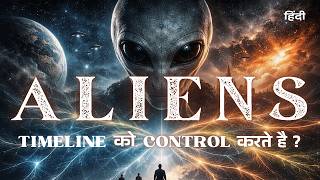
Are Aliens Guiding Our Timeline Without Contact ?
We often ask whether aliens exist. But a far more important question is why they might choose not to contact us. In this episode, we explore a deeper framework — one that connects branching timelines, multiverse logic, and advanced alien civilizations. We examine multiple possibilities: Why advanced civilizations may avoid direct contact How interference could destabilize timelines Whether aliens guide outcomes by subtly shifting probabilities And the unsettling idea that humanity may be part of a long-term experiment, not a rescue mission This is not science fiction and not belief-based speculation. It is a process-driven discussion built on logic, physics, history, and pattern analysis. No conclusions are forced. No sensational claims are made. Just uncomfortable possibilities — and questions that don’t disappear once you think about them. This episode sets the foundation for the next part, where we will explore past contact claims, abduction patterns, and genetic intervention theories with the same disciplined approach.
2026-02-24
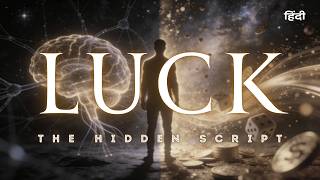
What If Luck is not Random at All ?
Luck is often called coincidence. But real-life events show something far more complex. In this video, we explore: Unbelievable real incidents of extreme luck Brutal unlucky events where probability turned fatal What science says about luck, consciousness, belief, and probability Why some people seem to succeed without struggle And a thought-provoking theory about karma, memory, and life patterns This is not a motivational video and not spiritual preaching. It is a calm exploration using real events, scientific concepts, and philosophical possibilities. If you’ve ever wondered why life treats people so differently — this video will make you think.
2026-02-22
Top Articles

Cosmic Cycles: Conceptual Parallels Between Hindu Philosophy, Cosmology, and Computational Processes
This article provides a structured analysis of the conceptual parallels between the tripartite model of creation, preservation, and transformation found in Hindu philosophy (Brahma, Vishnu, Shiva), the lifecycle of computational processes (initialize, process, complete), and modern cosmological theories (Big Bang, cosmic expansion, and end-of-universe scenarios). It examines these frameworks while maintaining strict scientific discipline, distinguishing between established theory, hypothesis, and philosophical narrative.
2026-02-25
Holographic Universe : Conceptual Parallels Between Modern Physics and Ancient Philosophy
This article examines the proposition that our perceived reality may be a projection, a concept explored in both modern theoretical physics and ancient philosophical traditions. It analyzes the scientific underpinnings of the Holographic Principle, its mathematical basis in the AdS/CFT correspondence, and the distinct philosophical argument of the Simulation Hypothesis. Furthermore, it draws carefully delineated conceptual parallels to metaphysical ideas such as Maya in Hinduism, Śūnyatā in Buddhism, Plato's Allegory of the Cave, and Gnostic cosmology, maintaining a clear distinction between scientific theory and philosophical narrative.
2026-02-25
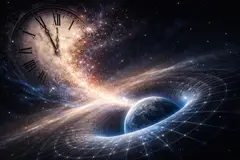
The Nature of Time: An Exploration from Classical Physics to Speculative Realities
This article provides a structured analysis of the concept of time, tracing its evolution from the absolute, universal clock of Newtonian physics to the dynamic, relative framework of Einstein's theories. It further explores the unresolved paradoxes in quantum mechanics, the philosophical implications of models like the Block Universe and the Many-Worlds Interpretation, and the scientific perspective on anomalous temporal experiences. The objective is to distinguish between established scientific theory, theoretical frameworks, and speculative interpretations, offering a clear and epistemically disciplined overview of one of science's most profound subjects.
2026-02-25
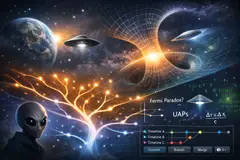
Extraterrestrial Intelligence and Spacetime: A Theoretical Framework for the Fermi Paradox and Potential Alien Motivations
This article synthesizes concepts from theoretical physics and speculative hypotheses to explore the nature of potential extraterrestrial intelligence. It examines the Fermi Paradox, the characteristics of Unidentified Anomalous Phenomena (UAPs), and the implications of spacetime manipulation. By drawing a conceptual parallel with version control systems, it proposes a model of 'branching timelines' to understand possible alien motivations, ranging from non-interference to subtle probabilistic influence, while maintaining strict scientific discipline and distinguishing established theory from speculation.
2026-02-24

The Architecture of Reality: A Synthesis of Modern Physics, Ancient Cosmology, and the Principle of Karma
This article examines the conceptual parallels between theoretical physics, particularly string theory's postulation of multiple dimensions, and the cosmological frameworks of ancient philosophies, such as the Hindu concept of 'lokas'. It further explores the philosophical principle of karma, reframing it as a system of causality and feedback rather than a moralistic judgment. The analysis synthesizes these ideas to provide a structured perspective on existence, suffering, and the potential for liberation from cyclical patterns, while carefully distinguishing between established science, theoretical frameworks, and philosophical narratives.
2026-02-24
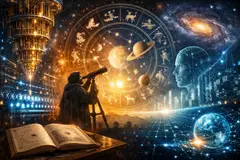
Quantum Computing, Ancient Cosmologies, and the Simulation Hypothesis: A Synthesis of Modern and Ancient Pattern-Seeking
This article explores the conceptual intersection of recent breakthroughs in quantum computing, ancient predictive systems like astrology, and speculative frameworks such as the simulation hypothesis. It examines the human quest to identify and decode patterns in reality, tracing a philosophical line from the celestial observations of antiquity to the data-driven models and quantum simulations of the modern era. The analysis maintains a clear distinction between established science, theoretical frameworks, and speculative interpretations, providing a structured overview of how technological advancements are prompting renewed inquiry into the fundamental nature of existence, consciousness, and purpose.
2026-02-24

The Phenomenology of Luck: A Synthesis of Scientific and Speculative Perspectives
This article examines the concept of luck by synthesizing scientific explanations with philosophical and speculative interpretations. It begins by presenting documented cases of extreme fortune and misfortune to illustrate the phenomenon's perceived power. The analysis then shifts to established scientific frameworks, including the roles of probability, cognitive biases like confirmation bias, and neurological mechanisms such as the Reticular Activating System (RAS) and neuroplasticity. Finally, the article explores the limits of these explanations and delves into speculative concepts, such as karma and reincarnation, framing them as cultural narratives and philosophical hypotheses that attempt to account for life experiences that defy conventional understanding.
2026-02-24

The Multiverse Hypothesis : From Quantum Theory to Ancient Cosmology
This article provides a structured analysis of the multiverse concept, beginning with its origins in quantum mechanics and cosmology. It examines the theoretical underpinnings, such as the Many-Worlds Interpretation and the fine-tuning problem, and critically evaluates purported evidence from physics and human experience. The analysis extends to exploring conceptual parallels found in ancient philosophical and religious texts, while maintaining a clear distinction between scientific theory, hypothesis, and cultural narrative.
2026-02-21