




Abstract
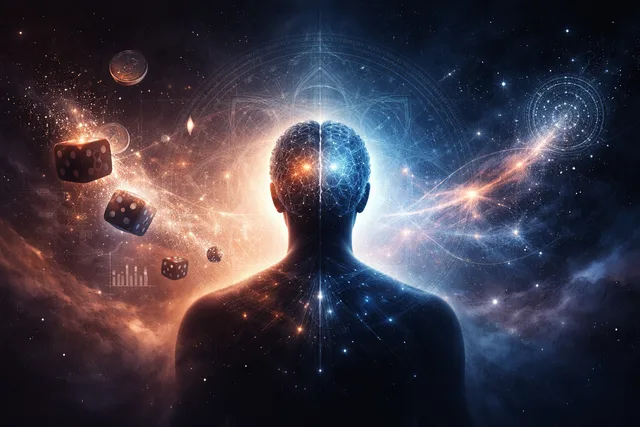
This article examines the concept of luck by synthesizing scientific explanations with philosophical and speculative interpretations. It begins by presenting documented cases of extreme fortune and misfortune to illustrate the phenomenon's perceived power. The analysis then shifts to established scientific frameworks, including the roles of probability, cognitive biases like confirmation bias, and neurological mechanisms such as the Reticular Activating System (RAS) and neuroplasticity. Finally, the article explores the limits of these explanations and delves into speculative concepts, such as karma and reincarnation, framing them as cultural narratives and philosophical hypotheses that attempt to account for life experiences that defy conventional understanding.
Introduction: The Enigma of Luck and Human Experience
Core Idea: The article introduces the central question of why life outcomes vary so dramatically among individuals, contrasting the roles of random chance, personal agency, and the possibility of underlying, unseen mechanisms.
The concepts of luck, fortune, and fate have been a source of human fascination for millennia. We observe that some individuals appear to navigate life with remarkable success and ease, while others face persistent struggle, even when circumstances seem comparable. This disparity raises fundamental questions: Are life's outcomes merely the product of random probability? Or are they shaped by our mindset, actions, and internal programming? This article seeks to explore these questions by examining the phenomenon of luck from multiple angles. It will begin by reviewing documented, though extreme, real-world events, then move to the established scientific frameworks that explain our experience of luck, and finally, consider the philosophical and speculative narratives that arise to explain what science currently cannot.
Case Studies in Extreme Fortune and Misfortune
Core Idea: A review of documented, high-profile cases that exemplify statistically improbable events, which are often interpreted through the lens of extreme 'luck' or 'unluck'.
To ground the discussion, it is useful to consider several well-documented cases of extreme statistical anomalies. Frane Selak, a Croatian music teacher, famously survived seven distinct life-threatening incidents, including a train derailment, a plane crash, and multiple car accidents, before later winning the lottery. Conversely, Roy Sullivan, a U.S. park ranger, was struck by lightning on seven different occasions. Other examples include Joan Ginther, who won multi-million dollar lottery jackpots four times, and Ann Hodges, the only person in recorded history confirmed to have been struck by a meteorite and survive. Disasters also provide a stark context. In the 1977 Tenerife airport disaster, the deadliest in aviation history, 583 people perished, yet some individuals survived simply because they missed their flight. Similarly, during the 2003 Station nightclub fire, proximity to an exit—a matter of seconds and inches—determined who lived and who died. While compelling, it is crucial to frame these anecdotes with scientific caution. They represent extreme statistical outliers and are often subject to reporting and survivorship bias, where the focus on the survivors obscures the much larger number of non-survivors.
Controversy Note: The dominant scientific explanation for these events is statistical probability. Extremely low-probability events are statistically certain to occur given a large enough sample size (billions of people over many decades). Attributing these events to a metaphysical force like 'luck' is an interpretation not supported by scientific evidence.
The Scientific Framework for 'Luck': Psychology and Neuroscience
Core Idea: Modern science interprets the experience of 'luck' through the lenses of cognitive psychology and neuroscience, emphasizing the role of internal brain mechanisms in shaping perception and behavior.
Rather than an external force, science largely explains 'luck' as a product of our own minds and behaviors. Several key concepts are central to this understanding:
1. The Reticular Activating System (RAS): This network of neurons in the brainstem acts as a filter for the vast amount of sensory information we receive. The RAS regulates arousal and attention, prioritizing stimuli that are relevant to our current thoughts, goals, and beliefs (Moruzzi & Magoun, 1949). For example, after deciding to buy a specific model of car, one suddenly seems to see it everywhere. The cars were always there; the RAS has simply tagged that information as important, making one consciously aware of it. This creates the illusion that the world is conforming to our thoughts.
2. Confirmation Bias and the Belief-Perception Loop: A well-established cognitive bias, confirmation bias is the tendency to search for, interpret, favor, and recall information that confirms one's preexisting beliefs (Wason, 1960). If an individual believes they are 'unlucky,' their brain will selectively focus on and remember negative events, reinforcing the belief. Conversely, a belief in one's own agency or 'luck' primes the brain to notice opportunities and positive outcomes, creating a self-fulfilling prophecy.
3. Neuroplasticity and Goal-Oriented Behavior: The brain is not static; it physically changes in response to experience and thought. This is neuroplasticity (Pascual-Leone et al., 2005). Repeatedly focusing on a goal, practicing a skill, or holding a specific mindset strengthens the corresponding neural pathways. This makes related thoughts and behaviors more automatic and efficient. What is often termed 'manifestation' can be understood scientifically as the process of using focused attention to rewire the brain, which in turn drives behaviors that increase the probability of achieving a desired result.
4. Bioelectrical Correlates of Emotion: Emotional states have distinct physiological signatures. Fear and anxiety are associated with specific patterns of brain activity (EEG) and heart rate variability (ECG), which often lead to risk-averse, narrow thinking. Confidence and optimism are correlated with different patterns that support broader thinking and calculated risk-taking. This difference in the nervous system's baseline bioelectrical activity influences decision-making and social interactions, which an outside observer might interpret as a person being 'lucky' or 'unlucky'.
Acknowledging the Limits of Conventional Explanation
Core Idea: While scientific models provide powerful explanations, they do not fully resolve the subjective experience or certain life circumstances, such as being born into privilege or possessing innate talent, which leads to alternative interpretations.
Despite the explanatory power of psychology and probability, these frameworks do not always satisfy the human search for meaning. They struggle to fully account for phenomena that feel fundamentally unearned or predetermined. For instance, the 'birth lottery'—being born into a wealthy, supportive family versus one in poverty—is a profound determinant of life outcomes that is entirely outside an individual's control. Similarly, child prodigies who display extraordinary talent with little to no formal training challenge simple models of learning and practice. While science would point to a complex, and not yet fully mapped, interplay of genetics, epigenetics, and early environmental factors, the sheer scale of these disparities leaves a conceptual void. It is in this void that philosophical and metaphysical narratives often take root, offering frameworks that speak to a sense of deeper order or justice.
Controversy Note: Mainstream science does not posit non-material or metaphysical causes for these phenomena. The current scientific consensus is that they result from a complex interaction of genetic predispositions, environmental influences, and stochastic (random) events, though the precise mechanisms are still an active area of research.
A Thought Experiment on Systemic Complexity and 'Time Windows'
Core Idea: An analogy is presented to conceptualize how a vast, complex system might manage individual outcomes, suggesting that 'luck' could be viewed as a temporary phase or 'window of opportunity' rather than a permanent trait.
To explore alternative ways of thinking, we can use a thought experiment. Imagine a manager responsible for the growth and well-being of billions of individuals. Direct, continuous, one-on-one management would be impossible due to the sheer scale and complexity of human needs and desires. A logical solution would be to create a system that works in phases or 'batches,' focusing resources and attention on different groups at different times. This is a purely metaphorical framework for conceptualizing luck. In this analogy, 'luck' is not a fixed personal attribute but a 'time window'—a period where an individual's actions, decisions, and growth are the focus of a larger systemic dynamic. This perspective shifts the concept of luck from a static label ('I am a lucky person') to a dynamic condition ('I am in a window of opportunity'). The model does not claim to describe reality but serves as a tool to think about fortune and struggle as potentially cyclical rather than permanent states.
Controversy Note: This is a purely philosophical analogy designed to provide a conceptual model. It is not a scientific theory and has no empirical basis.
Speculative Synthesis: Karma, Reincarnation, and the Subconscious
Core Idea: This section explores the speculative hypothesis that concepts like karma and reincarnation provide a narrative framework for unexplained life patterns, with the subconscious mind acting as a hypothetical bridge for continuity.
Certain philosophical and spiritual traditions, particularly from Eastern cultures, offer a narrative of continuity across lifetimes. The concept of karma posits that the sum of a person's actions and their consequences in one life determines their circumstances in the next. In this view, every life is a chapter in a larger journey of development. A life of struggle could be interpreted as a 'training phase,' and the progress made might lead to more favorable starting conditions, or 'shortcuts,' in a subsequent life. This framework attempts to provide a sense of ultimate fairness and purpose to seemingly random suffering or fortune.
A speculative hypothesis attempts to bridge this metaphysical concept with modern psychology by positing the subconscious mind as the carrier of this continuity. While there is no scientific evidence for memories transferring between lives, this hypothesis suggests that if such a process existed, these 'memories' would reside in the subconscious. They would not be accessible as explicit recollections but would manifest as innate talents, deep-seated fears, powerful intuitions, and predispositions. The existence of child prodigies or individuals with unexplainable innate skills is often cited as anecdotal support for this narrative. This represents a philosophical similarity, where a modern scientific concept (the subconscious) is used to provide a potential mechanism for an ancient metaphysical belief.
Controversy Note: The concepts of karma and reincarnation are metaphysical and not falsifiable, placing them outside the domain of scientific inquiry. There is no empirical evidence to support the existence of reincarnation or the transfer of memories across lifetimes. The claim that the subconscious controls 95% of life is a popular simplification of the balance between automatic and conscious cognitive processes.
Conclusion
The experience of luck is a complex interplay of objective reality and subjective interpretation. The most robust, evidence-based explanations are found in the fields of statistics, cognitive psychology, and neuroscience. Probability dictates that extremely unlikely events will occur, while our own neural filters and cognitive biases shape which events we notice and how we interpret them. Our mindset and behaviors, driven by the brain's neuroplasticity, demonstrably influence our path and outcomes. However, these scientific frameworks do not always resolve the profound existential questions about fairness and destiny that extreme life events provoke. Speculative narratives involving concepts like karma and reincarnation persist because they offer a framework of meaning, purpose, and continuity that science, by its nature, does not provide. Ultimately, navigating life requires both an appreciation for the empirical drivers of success and failure and a personal framework for making sense of the profound randomness and disparity inherent in the human condition.
References
Moruzzi, G., & Magoun, H. W. (1949). Brain stem reticular formation and activation of the EEG. Electroencephalography and Clinical Neurophysiology, 1(4), pp. 455-473. https://doi.org/10.1016/0013-4694(49)90219-0
Pascual-Leone, A., Amedi, A., Fregni, F., & Merabet, L. B. (2005). The plastic human brain cortex. Annual Review of Neuroscience, 28, pp. 377-401. https://doi.org/10.1146/annurev.neuro.27.070203.144216
Spanish Ministry of Transport and Communications (1978). Report on the collision of two Boeing 747 aircraft at Tenerife-Los Rodeos Airport, Spain, on 27 March 1977. Ministerio de Transportes y Comunicaciones.
Swain, G. A., & Dodson-Swain, H. S. (2019). The Sylacauga meteorite: The true story of the only person in recorded history to be struck by a meteorite. The University of Alabama Press.
Wason, P. C. (1960). On the failure to eliminate hypotheses in a conceptual task. Quarterly Journal of Experimental Psychology, 12(3), pp. 129-140. https://doi.org/10.1080/17470216008416717
Key Questions
Join the Reality Circle to discuss this topic further.
Join the Circle to discuss