




Abstract
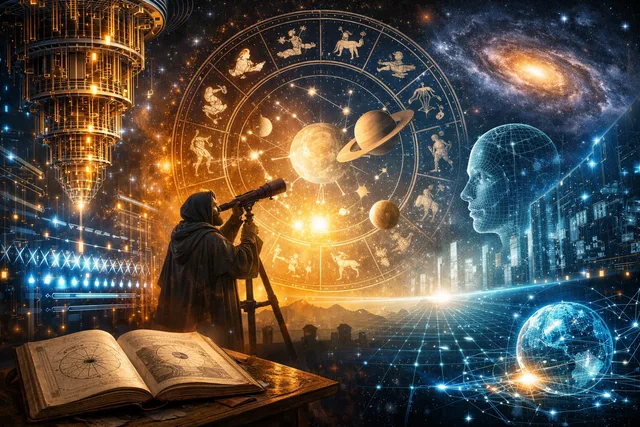
This article explores the conceptual intersection of recent breakthroughs in quantum computing, ancient predictive systems like astrology, and speculative frameworks such as the simulation hypothesis. It examines the human quest to identify and decode patterns in reality, tracing a philosophical line from the celestial observations of antiquity to the data-driven models and quantum simulations of the modern era. The analysis maintains a clear distinction between established science, theoretical frameworks, and speculative interpretations, providing a structured overview of how technological advancements are prompting renewed inquiry into the fundamental nature of existence, consciousness, and purpose.
The Computational Paradigm Shift: Quantum Computing's Impact on Our View of Reality
Core Idea: Recent achievements in quantum computing represent a fundamental shift in computational power, suggesting that reality itself may be understood as a complex computational system. These advances move beyond mere increases in speed to introduce a new paradigm for processing information.
In recent years, the field of quantum computing has produced results that challenge the limits of classical computation. A notable example is Google's Sycamore processor, which in 2019 performed a specific calculation in approximately 200 seconds that was estimated to take a state-of-the-art classical supercomputer around 10,000 years (Arute et al., 2019). Similarly, quantum annealers like those developed by D-Wave Systems have demonstrated the ability to simulate complex quantum magnetic materials in minutes, a task projected to take classical computers millennia. These are not merely incremental improvements; they represent a paradigm shift. Unlike classical bits, which exist as either 0 or 1, quantum bits (qubits) can exist in a superposition of both states simultaneously. This, combined with the principle of entanglement, allows quantum computers to explore a vast number of possibilities concurrently. The foundational work on quantum entanglement, which underpins these technologies, was recognized with the 2022 Nobel Prize in Physics awarded to Alain Aspect, John F. Clauser, and Anton Zeilinger. These developments are moving quantum computing from experimental physics to practical tools in fields like biotechnology and finance, prompting a re-evaluation of what is computationally possible and, by extension, the computational nature of reality itself.
Controversy Note: The claim of 'quantum supremacy' or 'quantum advantage' is an active area of research and debate. While quantum processors have demonstrated the ability to solve specific, contrived problems faster than classical computers, achieving a broad, fault-tolerant quantum advantage for practical, real-world problems remains a significant engineering challenge.
Citations in this section:
Arute, F., Arya, K., Babbush, R., Bacon, D., Bardin, J. C., Barends, R., et al. (2019). Quantum supremacy using a programmable superconducting processor. Nature, 574(7779), pp. 505-510. https://doi.org/10.1038/s41586-019-1666-5
The Nobel Prize (2022). The Nobel Prize in Physics 2022. NobelPrize.org. https://www.nobelprize.org/prizes/physics/2022/summary/
Ancient Predictive Models: Astrology and the Search for Cosmic Patterns
Core Idea: Long before modern science, astrology emerged as a complex, symbolic system for identifying patterns in the cosmos and correlating them with terrestrial events and human personality, based on the hermetic principle 'As above, so below.'
The human endeavor to understand and predict the future is not new. Millennia before the advent of supercomputers, ancient cultures developed systems to find order in what might otherwise seem a random existence. Astrology is one of the most enduring examples. It originated from the observation of cyclical patterns: the changing seasons, the phases of the moon, and the regular movements of celestial bodies. This led to the foundational belief that events in the heavens were connected to life on Earth. Astrology posits that by mapping the positions of planets and stars at the moment of an individual's birth (a natal chart or 'kundali'), one can decode their inherent nature, tendencies, strengths, and potential life path. In this framework, celestial bodies are not seen as inert objects but as symbolic representations of fundamental energies or archetypes—Mars as aggression, Venus as desire, Saturn as discipline and consequence. The resulting chart is a 'pattern map,' a symbolic model of an individual's life. While its scientific validity is not supported, its core ambition was to create a predictive engine based on observable, albeit misinterpreted, patterns.
Controversy Note: Astrology is considered a pseudoscience by the mainstream scientific community. Numerous empirical studies have failed to demonstrate any correlation between astrological predictions and actual life events or personality traits beyond the effects of chance and psychological biases like the Barnum effect.
The Evolution of Pattern Recognition: From Stars to Big Data
Core Idea: A conceptual parallel exists between the pattern-seeking goal of ancient astrology and the predictive analytics of modern data science. Both operate on the fundamental assumption that life is not random and that by analyzing the right inputs, future outcomes can be modeled.
When viewed through the lens of information processing, a philosophical similarity emerges between ancient and modern predictive systems. Astrology attempted to model a life's trajectory using a limited set of inputs: birth date, time, and location, which determined the celestial map. Modern predictive systems, powered by machine learning and big data, pursue a similar goal but with exponentially greater data and methodological rigor. They analyze vast datasets—from genetic information and medical records to consumer behavior and social media activity—to identify patterns and make predictions about health outcomes, market trends, and human behavior. The underlying premise is the same: existence is pattern-based. The key difference lies in the nature of the data and the validity of the model. Where astrology relied on symbolic correlation, modern science demands empirical validation and causal mechanisms. The conceptual thread, however, remains: the belief that with sufficient data and the correct analytical model, the future is not entirely unknowable.
The Hypothesis of Reincarnation and Anomalous Memories
Core Idea: The concept of reincarnation, found in many philosophical and spiritual traditions, offers a speculative framework for explaining life's non-random patterns, innate talents, and irrational fears. This hypothesis has been explored through research into cases of children who claim to remember past lives.
If life is indeed pattern-based, the question arises: what generates these patterns? Some life events and personal traits seem to stem from causes beyond an individual's current life experiences. This has led to speculative inquiries into the nature of consciousness and memory. The concept of reincarnation proposes that consciousness is not extinguished upon death but is reborn into a new life, carrying forward certain imprints, tendencies, or 'karmic' data. This idea has been the subject of systematic, though controversial, research. The late Dr. Ian Stevenson, a psychiatrist at the University of Virginia, spent decades documenting thousands of cases of young children who reported specific memories of a past life. These children sometimes provided detailed names, places, and events that were later verified. In some instances, they exhibited birthmarks or birth defects that corresponded to wounds on the body of the deceased person they claimed to have been (Stevenson, 1997). These narratives suggest the possibility of a 'layered memory system'—conscious, subconscious, and a deeper archival memory that transcends a single lifetime.
Controversy Note: The work of Ian Stevenson and the concept of reincarnation are not accepted by mainstream science. Dominant scientific explanations for such reported memories include cryptomnesia (forgotten memories mistaken for new information), confabulation, suggestion from family members, and confirmation bias in the investigation process. The evidence remains anecdotal and does not meet the standards of empirical proof required by the scientific method.
Citations in this section:
Stevenson, I. (1997). Reincarnation and Biology: A Contribution to the Etiology of Birthmarks and Birth Defects. Praeger Publishers.
A Technological Analogy: Parallel Evolutionary Optimization in AI
Core Idea: Modern AI training methods, particularly evolutionary algorithms, provide a powerful technological metaphor for how a system could optimize for a specific outcome across numerous isolated trials, mirroring the concept of multiple, separate lifetimes aimed at a common goal.
To solve highly complex problems, computer scientists often employ methods inspired by biological evolution. In techniques like genetic algorithms and parallel evolutionary optimization, a problem is not solved in a single attempt. Instead, hundreds or thousands of 'candidate solutions' (analogous to a population of organisms) are generated and tested simultaneously in isolated simulations. Each candidate has a slightly different configuration or strategy. After a round of testing, the most 'fit' or successful solutions are selected, 'recombined,' and 'mutated' to create a new generation of candidates. The less successful ones are discarded. This iterative process continues until an optimal solution is found (Holland, 1992). The key principle is isolation: the individual simulations are not aware of each other, preventing interference and ensuring a diverse exploration of the solution space. This method of parallel, isolated trial-and-error is an extremely effective way to navigate vast and complex problems.
Citations in this section:
Holland, J. H. (1992). Adaptation in natural and artificial systems: An introductory analysis with applications to biology, control, and artificial intelligence. MIT Press.
The Simulation Hypothesis as a Unifying Speculative Framework
Core Idea: The simulation hypothesis offers a speculative framework that conceptually integrates reincarnation, karmic patterns, and a teleological purpose by proposing that our reality is one of many parallel simulations, run by a higher intelligence to solve a complex problem or achieve an optimal state of evolution.
If humanity finds parallel evolutionary optimization to be an effective strategy, it is conceivable that a more advanced intelligence would employ a similar system on a cosmic scale. This is the conceptual core of one interpretation of the simulation hypothesis. In this view, each individual life or lifetime could be an isolated 'simulation run.' The goal is to evolve consciousness or behavior toward an optimal outcome. The isolation of each 'run' would explain why we do not perceive other lives or the 'creator' of the simulation. Our reality, with its fixed physical laws, would be the parameters of the simulation. Within this framework, phenomena that are otherwise anomalous find a metaphorical explanation. Past-life memories, déjà vu, or innate talents could be interpreted as 'data leakage' or 'breadcrumbs' from previous, terminated simulation runs. The overarching 'mission' or 'karmic task' would be the optimization problem that the entire system is designed to solve. This reframes existence not as a random accident, but as a structured, purpose-driven process of evolution and refinement.
Controversy Note: The simulation hypothesis is a philosophical proposition, not a scientific theory. It is currently considered unfalsifiable, as any evidence could be interpreted as part of the simulation itself. While it provides a compelling narrative, it lacks empirical evidence and predictive power.
Conclusion
The journey from the tangible breakthroughs of quantum computing to the speculative realms of the simulation hypothesis highlights a profound continuity in human thought: the search for meaning through the decoding of patterns. While quantum mechanics and AI algorithms are products of rigorous scientific inquiry, concepts like reincarnation and a simulated reality remain in the domain of philosophical speculation. The parallel between ancient astrology's symbolic maps and modern AI's predictive models serves not as an equivalence of validity, but as a reflection of a shared, fundamental assumption that our universe is intelligible. As our technological capacity to model complexity grows, it naturally provokes deeper questions about the ultimate nature of the reality we are modeling. Whether these inquiries will lead to a convergence of scientific and philosophical understanding remains an open question, representing the next frontier in our quest to comprehend our place in the cosmos.
References
Arute, F., Arya, K., Babbush, R., Bacon, D., Bardin, J. C., Barends, R., et al. (2019). Quantum supremacy using a programmable superconducting processor. Nature, 574(7779), pp. 505-510. https://doi.org/10.1038/s41586-019-1666-5
Holland, J. H. (1992). Adaptation in natural and artificial systems: An introductory analysis with applications to biology, control, and artificial intelligence. MIT Press.
Stevenson, I. (1997). Reincarnation and Biology: A Contribution to the Etiology of Birthmarks and Birth Defects. Praeger Publishers.
The Nobel Prize (2022). The Nobel Prize in Physics 2022. NobelPrize.org. https://www.nobelprize.org/prizes/physics/2022/summary/
Key Questions
Join the Reality Circle to discuss this topic further.
Join the Circle to discuss