




Abstract
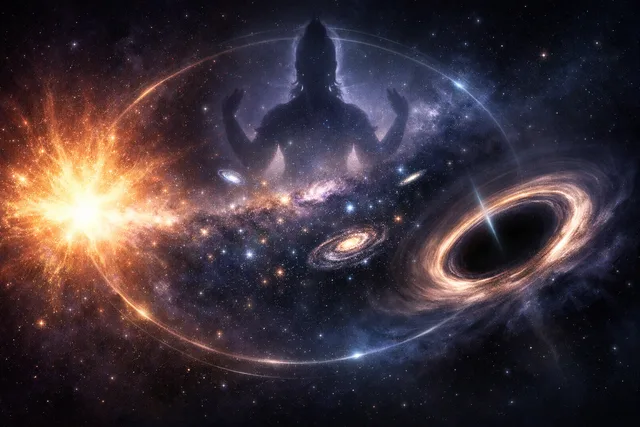
This article provides a structured analysis of the conceptual parallels between the tripartite model of creation, preservation, and transformation found in Hindu philosophy (Brahma, Vishnu, Shiva), the lifecycle of computational processes (initialize, process, complete), and modern cosmological theories (Big Bang, cosmic expansion, and end-of-universe scenarios). It examines these frameworks while maintaining strict scientific discipline, distinguishing between established theory, hypothesis, and philosophical narrative.
The Enduring Nature of Belief and the Quest for Meaning
Core Idea: Belief in a higher power or a transcendent order often serves as a psychological framework for providing hope, meaning, and a sense of control in the face of uncertainty and the limits of human understanding.
Throughout human history, across diverse cultures and technological epochs, the concept of 'God' or a divine principle has remained a persistent element of civilization. From a psychological and anthropological perspective, such belief systems can be understood as powerful mechanisms for coping with existential questions and navigating circumstances that appear to be beyond individual control. When logical frameworks or empirical evidence are insufficient to provide comfort or explanation, belief can offer a sense of certainty and hope. The subjective experience of a 'divine' presence or intervention, as described in many cultural narratives, is a powerful psychological phenomenon that reinforces these belief structures. The persistence of such concepts is not evidence of their empirical reality but rather highlights a fundamental human need for meaning, order, and a narrative that transcends the observable world. The core question is not whether a deity exists, but how these conceptual frameworks help structure human experience.
The Hindu Trimurti: A Philosophical Model of Cosmic Functions
Core Idea: In Hindu philosophy, the Trimurti—Brahma, Vishnu, and Shiva—represent not static entities but the personification of three fundamental, cyclical functions that govern the cosmos: creation, preservation, and transformation.
The Hindu tradition conceptualizes the universe as a dynamic and cyclical entity. This process is often personified by the Trimurti. Brahma is associated with the principle of creation (Srishti), representing the universe's beginning. Vishnu embodies the principle of preservation (Sthiti), sustaining cosmic order, law, and structure. Shiva represents the principle of dissolution or transformation (Samhara), which is not merely an end but a necessary precursor to renewal and a new cycle of creation. This tripartite model is not a linear, one-time event but a continuous, recurring process known as the 'Kalachakra' or wheel of time. This philosophical framework views creation, maintenance, and destruction as inseparable and perpetually interacting functions, analogous to natural cycles like birth, life, and death, which are seen as integral parts of a larger, ongoing process.
Cosmological Origins: The Big Bang Theory
Core Idea: The Big Bang theory, the leading scientific model for the universe's origin, describes its emergence from an extremely hot, dense singularity. This scientific concept of a singular origin point offers a conceptual parallel to the creation principle in philosophical narratives.
According to the established Big Bang theory, all matter and energy in the observable universe were initially concentrated in an infinitesimally small, hot, and dense point known as a singularity. Approximately 13.8 billion years ago, this point began to expand rapidly, an event that marks the beginning of the universe, time, and space as we know them. This model is supported by extensive empirical evidence, including the observed expansion of the universe, the cosmic microwave background radiation, and the abundance of light elements. While the Hindu concept of creation by Brahma is a philosophical and mythological narrative, it shares a conceptual similarity with the Big Bang in that both frameworks posit a singular, definitive beginning for the cosmos. It is crucial to understand this as a metaphorical resemblance, not a scientific equivalence or a claim that ancient texts predicted modern physics.
Citations in this section:
Lemaître, G. (1927). Un Univers homogène de masse constante et de rayon croissant rendant compte de la vitesse radiale des nébuleuses extra-galactiques. Annales de la Société Scientifique de Bruxelles, A47, pp. 49–59.
Cosmic Expansion as a Metaphor for Preservation
Core Idea: The ongoing expansion of the universe, which allows for the formation and evolution of galaxies, stars, and planets, can be viewed as a metaphorical parallel to the principle of preservation and sustenance embodied by Vishnu.
Following the initial Big Bang, the universe has been continuously expanding and cooling. This expansion, confirmed by observations that distant galaxies are receding from us (Hubble & Humason, 1931), is the current phase of our universe's evolution. During this 'process' stage, gravity has drawn matter together to form the large-scale structures we observe today, including galaxies, stars, and planetary systems. This cosmic era allows for the conditions necessary for life to potentially emerge and evolve. In this context, the universe's current state of sustained expansion and structural development bears a philosophical similarity to the role of Vishnu in the Hindu Trimurti, which is to maintain and preserve cosmic order. This parallel illustrates a phase of sustenance and operation that follows an initial act of creation.
Citations in this section:
Hubble, E. (1929). A relation between distance and radial velocity among extra-galactic nebulae. Proceedings of the National Academy of Sciences, 15(3), pp. 168–173. https://doi.org/10.1073/pnas.15.3.168
The Ultimate Fate of the Universe: Hypotheses of Transformation
Core Idea: Scientific hypotheses regarding the end of the universe, such as the Big Crunch or the Big Bounce, provide a conceptual parallel to the transformative or regenerative dissolution principle represented by Shiva.
The ultimate fate of the universe is a major open question in cosmology, with several competing hypotheses based on the universe's density, the nature of dark energy, and its overall geometry. The primary scenarios include:
- Heat Death (or Big Freeze): If the universe continues to expand indefinitely, it will eventually cool to a state of maximum entropy, where all thermodynamic free energy is exhausted, leaving it cold, dark, and lifeless.
- The Big Crunch: If the average density of the universe is high enough, gravitational attraction will eventually overcome the expansion, causing the universe to collapse back into a hot, dense singularity, similar to its starting point.
- The Big Bounce: This is a speculative, cyclical model where a Big Crunch triggers a subsequent Big Bang, leading to a new universe. In this framework, the universe undergoes endless cycles of expansion and contraction (Battefeld & Peter, 2015).
These scenarios, particularly the Big Bounce, share a striking philosophical similarity with the role of Shiva and the concept of the Kalachakra. Shiva's role is not just one of destruction but of transformation, paving the way for a new creation. The Big Bounce hypothesis provides a modern scientific framework that metaphorically resembles this ancient idea of a cyclical cosmos that ends only to begin anew.
Controversy Note: The ultimate fate of the universe remains a subject of active research and debate in the scientific community. Current observations of accelerating expansion favor the 'Heat Death' scenario, but the nature of dark energy is not fully understood, leaving other possibilities open.
Citations in this section:
Battefeld, T. (2015). Cosmological Bounces and Bouncing Cosmologies. Physics Reports, 571, pp. 1-66. https://doi.org/10.1016/j.physrep.2014.12.004
Conclusion
The analysis reveals a recurring tripartite structure—beginning, sustenance, and transformation—across disparate domains: the philosophical narrative of the Hindu Trimurti, the scientific model of the universe's lifecycle, and even the logic of computational processes. This pattern does not imply a causal link or that ancient texts contained scientific knowledge. Rather, it highlights a fundamental cognitive tendency to organize complex processes into distinct, sequential phases. The parallels between Brahma and the Big Bang, Vishnu and cosmic expansion, and Shiva and end-of-universe theories are best understood as powerful metaphorical resemblances. They reflect a shared human endeavor to comprehend our reality by structuring it into a coherent narrative of origin, existence, and conclusion, whether that conclusion is an absolute end or a transition to a new beginning.
References
Battefeld, T., & Peter, P. (2015). Cosmological Bounces and Bouncing Cosmologies. Physics Reports, 571, pp. 1-66. https://doi.org/10.1016/j.physrep.2014.12.004
Hubble, E. (1929). A relation between distance and radial velocity among extra-galactic nebulae. Proceedings of the National Academy of Sciences, 15(3), pp. 168–173. https://doi.org/10.1073/pnas.15.3.168
Lemaître, G. (1927). Un Univers homogène de masse constante et de rayon croissant rendant compte de la vitesse radiale des nébuleuses extra-galactiques. Annales de la Société Scientifique de Bruxelles, A47, pp. 49–59.
Key Questions
Join the Reality Circle to discuss this topic further.
Join the Circle to discuss