




Abstract
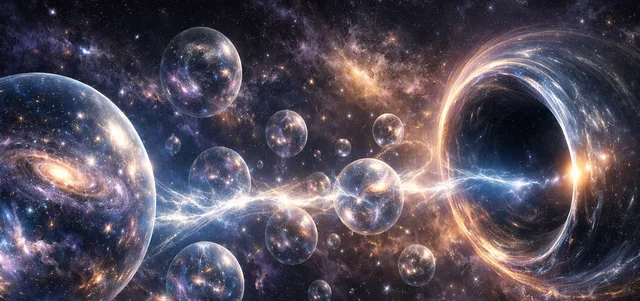
This article provides a structured analysis of the multiverse concept, beginning with its origins in quantum mechanics and cosmology. It examines the theoretical underpinnings, such as the Many-Worlds Interpretation and the fine-tuning problem, and critically evaluates purported evidence from physics and human experience. The analysis extends to exploring conceptual parallels found in ancient philosophical and religious texts, while maintaining a clear distinction between scientific theory, hypothesis, and cultural narrative.
Introduction: The Simulation Hypothesis and the Question of Purpose
Core Idea: The concept of our reality being a simulated or programmed construct raises fundamental questions about its ultimate purpose, suggesting that such a complex system would likely serve a function beyond mere entertainment.
The notion that our perceived reality is not the fundamental layer of existence has been explored in philosophy and, more recently, in theoretical physics. A popular framing of this idea is the Simulation Hypothesis, which posits that our universe could be an advanced computer simulation. This leads to a critical question: If our world is an engineered reality, what is its purpose? The sheer complexity of the universe—its intricate physical laws, detailed biology, and the emergence of consciousness—suggests that if it were a creation, its purpose would likely be more profound than simple amusement. The immense computational resources required would imply a significant objective, such as data collection, problem-solving, or understanding the nature of existence itself. This article explores one of the most compelling scientific frameworks that touches upon this idea: the multiverse.
Controversy Note: The Simulation Hypothesis, popularized by philosopher Nick Bostrom, is a philosophical proposition and not a testable scientific theory at present. It remains a subject of debate among physicists and philosophers.
Quantum Reality: Superposition and the Observer Effect
Core Idea: Quantum mechanics reveals a reality that defies classical intuition, where particles can exist in multiple states simultaneously (superposition) until an act of observation forces them into a single, definite state.
At the subatomic level, the universe operates according to the principles of quantum mechanics, which differ radically from the predictable laws of classical physics. A central concept is 'quantum superposition,' where a particle like an electron can exist in a probabilistic combination of all its possible states at once. For instance, it can be in multiple locations or have multiple spin values simultaneously. This state of potentiality persists until a measurement or observation is made. The 'observer effect' describes the phenomenon where the act of observation appears to compel the particle to 'collapse' from its wave of possibilities into a single, definite state. A common analogy is a spinning coin; while in the air, it is neither heads nor tails but a superposition of both. Only when it lands and is observed does it resolve into one outcome. This collapse of the wave function is one of the deepest mysteries in physics and serves as a primary branching point for different interpretations of quantum reality.
Controversy Note: While the mathematical framework of quantum mechanics and the phenomenon of superposition are experimentally verified, the nature of the 'observer' and the mechanism of wave function collapse are subject to intense debate, leading to various interpretations (e.g., Copenhagen, Many-Worlds).
The Many-Worlds Interpretation: A Universe for Every Possibility
Core Idea: The Many-Worlds Interpretation (MWI) proposes that instead of collapsing, the quantum wave function branches at every decision point, creating separate, parallel universes for each possible outcome.
To address the question of what happens to all the other possibilities when a quantum system collapses into one state, physicist Hugh Everett III proposed the Many-Worlds Interpretation in 1957. According to MWI, the wave function never truly collapses. Instead, every time a quantum measurement is made, the universe splits into multiple branches. In each branch, one of the possible outcomes becomes the reality. This implies that for every choice you make, from the mundane to the life-altering, a version of you exists in a parallel universe who made a different choice. All these universes are equally real but do not interact with one another. From this perspective, the multiverse is not a speculative addition to science but a direct consequence of taking the mathematics of quantum mechanics at face value, without adding an ad-hoc collapse postulate.
Controversy Note: MWI is a leading interpretation of quantum mechanics but is not universally accepted. Critics point to its untestability (as the parallel worlds are, by definition, unobservable) and its violation of Occam's razor due to the postulation of an immense number of universes. It is an interpretation, not a standalone predictive theory.
The Fine-Tuned Universe and the Anthropic Principle
Core Idea: The fundamental constants of our universe appear to be precisely calibrated for the existence of life, a phenomenon that the multiverse hypothesis explains as a selection effect: we simply exist in one of the rare universes where conditions are right.
Cosmologists have observed that the fundamental constants and initial conditions of our universe are exquisitely 'fine-tuned' for the emergence of complex structures like stars, planets, and life. If the strength of gravity, the mass of the electron, or the expansion rate of the early universe were different by even a minuscule fraction, the cosmos as we know it would not exist. This observation presents two primary possibilities. The first is that this fine-tuning is an extraordinary coincidence. The second, which aligns with the multiverse concept, is the Anthropic Principle. This principle suggests that if an infinite or vast number of universes exist, each with random physical constants, it is not surprising that we find ourselves in one of the few that can support observers. Most universes would be sterile and lifeless. This idea is supported by many prominent physicists, including Stephen Hawking and Max Tegmark, as a potential solution to the fine-tuning problem.
Controversy Note: The Anthropic Principle is controversial. Some scientists argue it is a tautology ('we observe the universe to be this way because if it were different, we wouldn't be here to observe it') and lacks explanatory power. It is a philosophical principle applied to a physical observation.
The Multiverse as a Cosmic Problem-Solving System
Core Idea: A multiverse can be conceptualized as a vast, parallel processing system, where an advanced intelligence could test countless possibilities simultaneously to ensure the success of complex objectives, making it a necessity rather than a luxury.
To understand the potential utility of a multiverse, consider a thought experiment. Imagine being tasked with a seemingly simple goal, like ensuring ten fresh bananas are on a table every morning, but with unlimited resources. Initially easy, the task soon encounters countless challenges: supply chain disruptions, agricultural failures, economic collapse, natural disasters. To guarantee success, you would not rely on a single plan but would create multiple, redundant, parallel systems—diverse suppliers, storage facilities, and delivery routes. Now, scale this problem to a task of cosmic complexity, such as creating and sustaining life on a planet. The variables become nearly infinite. An intelligence facing such a challenge would likely not risk failure on a single attempt. It would run countless parallel 'experiments' or 'simulations'—each a separate universe or timeline—to explore every permutation and find pathways to a successful outcome. In this view, the multiverse is not a random byproduct but a necessary architecture for managing complexity and ensuring that vital outcomes are achieved.
An Examination of Potential Evidence and Anomalies
Core Idea: Various phenomena in physics and human experience, from quantum entanglement to the Mandela Effect, are sometimes cited as potential hints of a multiverse, though mainstream scientific explanations are often more conventional.
While direct proof of other universes is currently beyond our reach, some phenomena are interpreted by proponents as suggestive clues. It is crucial to evaluate these with scientific discipline:
1. Double-Slit Experiment & Entanglement: The double-slit experiment demonstrates that particles behave as waves of probability until observed. Quantum entanglement, which Albert Einstein called 'spooky action at a distance,' shows that two linked particles can instantaneously affect each other over vast distances. While these phenomena confirm the non-local and probabilistic nature of quantum reality, they are fundamental features of our own universe. They are the basis for interpretations like MWI but are not independent evidence for it.
2. The Cosmic Cold Spot: This is a real, unusually large and cold region in the Cosmic Microwave Background (CMB) radiation. One speculative hypothesis suggests it could be a 'bruise' from a collision between our universe and another. However, more conventional explanations, such as it being a vast supervoid containing fewer galaxies, are also being actively investigated and are considered more plausible by many cosmologists.
3. The Mandela Effect: This refers to a collective misremembering of common facts or events. The dominant scientific explanation is psychological, involving confabulation, false memories, and the fallibility of human memory, often reinforced by social suggestion. The interpretation that this is evidence of 'timeline shifts' or merging realities is highly speculative and not supported by scientific evidence.
4. Near-Death Experiences (NDEs): Individuals report profound experiences during clinical death, often involving out-of-body sensations and encounters with other realms. The scientific consensus attributes these experiences to neurochemical and physiological processes in a traumatized brain, such as hypoxia or temporal lobe activity. The interpretation of NDEs as glimpses into parallel dimensions is a metaphysical one, not a scientific one.
5. Consciousness Experiments: Research, such as that conducted by the Princeton Engineering Anomalies Research (PEAR) lab, claimed to show that human intention could slightly influence random physical systems. However, these findings are highly controversial, have not been replicated to the satisfaction of the broader scientific community, and are often criticized for methodological flaws. They are not considered established science.
Controversy Note: The claims listed are a mix of established phenomena (entanglement, Cold Spot) and subjective experiences (NDEs, Mandela Effect). Their interpretation as evidence for a multiverse is highly speculative and distinct from mainstream scientific consensus, which offers more parsimonious explanations for each.
Conceptual Parallels in Ancient Indian Philosophy
Core Idea: Ancient Indian texts describe a layered cosmos with multiple realms ('lokas'), variable flows of time, and infinite realities, which bear a conceptual resemblance to modern multiverse theories.
Long before the advent of modern physics, ancient philosophical systems, particularly those from India, developed cosmological models with striking conceptual parallels to multiverse theories. These are philosophical or metaphorical resemblances, not scientific equivalences.
- Multiple Realms (Lokas): Puranic and Vedic literature describes a hierarchy of numerous realms or planes of existence (lokas), from lower realms like 'Patala' to higher celestial realms of the gods ('Devas'). These are not just physical places but are often described as different vibrational states with their own beings and laws, a concept that metaphorically resembles the idea of co-existing parallel dimensions.
- Relative Time Flow: Texts like the Surya Siddhanta and the Mahabharata explicitly state that time flows at different rates in different lokas. A day for the gods is said to equal many years for humans. This presents a philosophical similarity to the concept of time dilation in Einstein's theory of relativity, where time is relative to the observer's gravitational field and velocity.
- Parallel Existence and Timelines: The Mahabharata contains episodes that can be interpreted as hinting at parallel timelines. For example, when Arjuna visits a celestial realm, only a short time passes for him, while years go by on Earth. In other narratives, Lord Krishna is described as being present in multiple places simultaneously, which can be seen as a metaphorical parallel to quantum superposition or existence in multiple branches of reality.
- The Cosmic Vision (Vishwaroopa): In the Bhagavad Gita, Arjuna is granted a divine vision of Krishna's universal form (Vishwaroopa), in which he beholds infinite universes, infinite forms, and infinite timelines all existing simultaneously within a single being. This description provides a powerful and ancient metaphorical visualization of a multiverse concept.
Controversy Note: These are interpretive parallels. It is an anachronism to claim that these ancient texts contained scientific knowledge of modern physics. They represent sophisticated mythological and philosophical frameworks for understanding reality, not empirical theories.
Speculative Access: Genius, Intuition, and Prophecy
Core Idea: The extraordinary insights of historical figures, from prophets to scientific geniuses, are sometimes speculatively interpreted as brief 'glimpses' into a deeper, multi-layered reality or a higher-dimensional information field.
Throughout history, certain individuals have demonstrated knowledge or insight that seemed far beyond their time. While mainstream explanations focus on exceptional cognitive abilities or coincidence, alternative interpretations frame these as moments of access to a non-linear or higher-dimensional reality.
- Prophecy: Figures like Nostradamus and Baba Vanga are credited with predictions of future events. Scientifically, such claims are viewed with skepticism, as the 'prophecies' are often vague and their accuracy is established through retroactive interpretation. There is no scientific evidence for precognition.
- Mathematical and Scientific Genius: The mathematician Srinivasa Ramanujan claimed his advanced formulas were revealed to him in dreams by a goddess. Albert Einstein famously used 'thought experiments,' such as imagining riding alongside a beam of light, to develop his theory of relativity. While Ramanujan's experience is a subjective one and Einstein's method is a form of structured imagination, some speculative interpretations suggest these minds were tapping into a deeper, non-local field of information, akin to 'downloading' insights from a higher-dimensional reality.
These interpretations remain firmly in the realm of speculation. The dominant scientific view is that genius and intuition are products of complex, albeit not fully understood, neural processes within the human brain.
Controversy Note: There is no scientific evidence to support the idea that intuition, prophecy, or genius are the result of accessing other dimensions or timelines. These interpretations are metaphysical and are not part of accepted scientific discourse.
Synthesis: A Layered Reality Centered on Consciousness
Core Idea: Synthesizing these diverse threads—from quantum physics to philosophical narrative—suggests a model of reality as a multi-layered architecture where consciousness is not a mere byproduct but a central, potentially interactive element.
When viewed together, the concepts of quantum superposition, the Many-Worlds Interpretation, fine-tuning, and the conceptual parallels in ancient thought converge on a compelling, albeit speculative, model of reality. This model portrays existence not as a single, linear, physical stage, but as a layered architecture of information and possibility. In this framework, the physical world we experience is one layer, built upon a deeper quantum foundation of potentiality. Parallel timelines or universes may exist as adjacent layers. Consciousness, in this view, is not simply an emergent property of matter but could be a fundamental bridge or node within this network, capable of both observing and, as some interpretations suggest, influencing which possibilities become manifest. This perspective reframes human existence from being a passive outcome of random processes to being an active participant in a vast, interconnected, multi-dimensional system.
Conclusion
The journey from the quantum world to the multiverse is a testament to humanity's drive to comprehend the ultimate nature of reality. While the Many-Worlds Interpretation and the Simulation Hypothesis provide provocative frameworks, they remain on the frontiers of theoretical science and philosophy. The parallels found in ancient texts highlight a long-standing human intuition that reality is more complex than it appears. However, it is essential to maintain epistemic discipline, clearly separating established scientific theory from speculative hypotheses and philosophical metaphors. The multiverse remains an unproven but powerful idea that challenges our most basic assumptions about existence, suggesting that our single reality may be but one page in a vast cosmic library.
References
Bostrom, N. (2003). Are You Living in a Computer Simulation?. . https://doi.org/10.1111/1467-9213.00309
Einstein, A., Podolsky, B., & Rosen, N. (1935). Can Quantum-Mechanical Description of Physical Reality Be Considered Complete?. . https://doi.org/10.1103/PhysRev.47.777
Everett, H. (1957). 'Relative State' Formulation of Quantum Mechanics. . https://doi.org/10.1103/RevModPhys.29.454
Key Questions
Join the Reality Circle to discuss this topic further.
Join the Circle to discuss