




Abstract
This article provides a structured analysis of the concept of time, tracing its evolution from the absolute, universal clock of Newtonian physics to the dynamic, relative framework of Einstein's theories. It further explores the unresolved paradoxes in quantum mechanics, the philosophical implications of models like the Block Universe and the Many-Worlds Interpretation, and the scientific perspective on anomalous temporal experiences. The objective is to distinguish between established scientific theory, theoretical frameworks, and speculative interpretations, offering a clear and epistemically disciplined overview of one of science's most profound subjects.
From Absolute Clockwork to a Relative Fabric: The Evolution of Time in Physics
Core Idea: The scientific understanding of time underwent a fundamental revolution, shifting from Isaac Newton's concept of a universal, absolute time to Albert Einstein's theory of a relative, malleable spacetime.
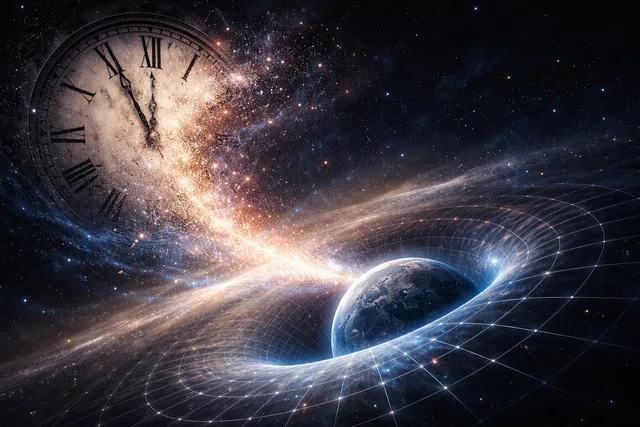
For centuries, the dominant scientific model of time was that proposed by Isaac Newton. In this framework, time was conceived as an absolute and independent entity, flowing at a constant rate for all observers throughout the universe, akin to the ticking of a universal clock. This classical view treated time as a steady, one-dimensional progression from past to future. However, this conception was dramatically overturned in the early 20th century by Albert Einstein's theories of relativity. Einstein's special relativity (1905) and general relativity (1916) demonstrated that time is not absolute. Instead, it is intrinsically linked to space, forming a four-dimensional continuum known as spacetime. The rate at which time passes is relative to an observer's velocity and the strength of the local gravitational field. This phenomenon, known as time dilation, means that time can slow down for an object moving at high speeds or in the presence of a massive body. Spacetime is not a passive background but a dynamic fabric that can be bent and warped by mass and energy, and time itself bends along with it.
Citations in this section:
Einstein, A. (1916). Die Grundlage der allgemeinen Relativitätstheorie. Annalen der Physik, 354(7), pp. 769–822. https://doi.org/10.1002/andp.19163540702
The Arrow of Time: A Macroscopic Certainty and a Quantum Enigma
Core Idea: While our everyday experience and the laws of thermodynamics point to a clear directional flow of time from past to future (the 'Arrow of Time'), the fundamental equations of quantum mechanics are time-symmetric, creating a profound conflict in our understanding.
Despite the malleability of time in relativity, our subjective experience is one of a relentless, unidirectional flow. This is known in physics as the 'Arrow of Time,' a concept popularized by astrophysicist Arthur Eddington. The dominant scientific explanation for this directionality is the Second Law of Thermodynamics. This law states that in an isolated system, entropy—a measure of disorder or randomness—tends to increase over time. The universe's natural progression from a state of low entropy (order, like the early universe) to high entropy (disorder, or chaos) gives time its apparent forward direction. However, a significant puzzle arises when we examine the quantum realm. The fundamental equations of quantum mechanics and general relativity do not inherently distinguish between past and future; they are time-reversal symmetric, meaning they work equally well forwards or backwards in time. This discrepancy between the time-symmetric laws governing the micro-world and the time-asymmetric experience of the macro-world is one of the deepest unsolved problems in physics. It fails to explain the fundamental nature of 'now' or why we remember the past but not the future.
Controversy Note: The origin of the thermodynamic arrow of time and its connection to the cosmological arrow of time (the expansion of the universe) and the psychological arrow of time (our perception) is an area of active debate and research in theoretical physics and cosmology.
Citations in this section:
Eddington, A. S. (1928). The Nature of the Physical World. Macmillan.
The Block Universe Hypothesis: Time as a Persistent Illusion
Core Idea: Stemming from interpretations of relativity, the Block Universe hypothesis suggests that past, present, and future all exist simultaneously and are equally real, with human consciousness merely experiencing them in a sequential manner.
One speculative resolution to the puzzles of time is the Block Universe theory, also known as eternalism. This model conceptualizes spacetime as a static, four-dimensional block containing all events that have ever happened or ever will happen. In this view, the flow of time is an illusion of human consciousness. Just as all points in space exist simultaneously, all moments in time—past, present, and future—are equally real and fixed within this block. Our perception of a moving 'present' is likened to a spotlight moving along this pre-existing timeline, or a reader turning the pages of a book whose entire story is already written. This perspective found philosophical resonance with Albert Einstein, who once wrote in a letter of condolence that for physicists, 'the distinction between past, present and future is only a stubbornly persistent illusion.' While it is a logically consistent interpretation of relativity, the Block Universe remains a hypothesis, as it is not currently possible to empirically test the simultaneous existence of all moments in time.
Controversy Note: The Block Universe model is highly controversial as it implies a deterministic universe, potentially negating the concepts of free will and objective change. It is a topic of intense debate among physicists and philosophers of time.
Branching Timelines: The Many-Worlds Interpretation of Quantum Mechanics
Core Idea: The Many-Worlds Interpretation (MWI) of quantum mechanics proposes that every quantum event with multiple possible outcomes causes the universe to split into a corresponding number of parallel universes, each representing one of the outcomes.
An alternative to the single, fixed timeline of the Block Universe is offered by the Many-Worlds Interpretation (MWI), a theoretical framework first proposed by Hugh Everett III. MWI attempts to resolve the measurement problem in quantum mechanics, where a quantum system exists in a superposition of multiple states until it is measured, at which point it 'collapses' into a single state. Instead of a collapse, Everett proposed that all possible outcomes of a quantum measurement actually occur, each in its own separate, parallel universe. In this model, every decision or quantum event creates a branching of reality. For example, a thought experiment involving three time travelers aiming for the same future spacetime coordinate could result in them arriving in three distinct realities: one might find an advanced civilization, another a desolate planet, and the third a world similar to their own. This is because each quantum fluctuation or decision point on their journey could have created a new branch of the 'multiverse.' While MWI is considered an elegant solution by some physicists, it remains a speculative interpretation. There is no direct empirical evidence for the existence of these parallel universes, and they are, by their nature, causally disconnected from our own.
Controversy Note: MWI is one of several competing interpretations of quantum mechanics (along with the Copenhagen interpretation, pilot-wave theory, etc.). Its primary criticisms include its ontological extravagance (the postulation of an infinite number of unobservable universes) and its failure to explain the perceived probabilities of quantum outcomes (the Born rule).
Citations in this section:
Everett, H. (1957). 'Relative State' Formulation of Quantum Mechanics. Reviews of Modern Physics, 29(3), pp. 454–462. https://doi.org/10.1103/RevModPhys.29.454
Anomalous Temporal Experiences: Subjective Accounts and Scientific Scrutiny
Core Idea: Anecdotal reports of 'time slips' or shifts in reality, while compelling as narratives, are not considered scientific evidence. The dominant scientific approach is to seek explanations in psychological or neurological phenomena rather than literal breaches in the laws of physics.
Throughout history, there have been anecdotal accounts of individuals experiencing what they perceive as a 'glitch' in time or a shift into an alternate reality. One famous case is the Moberly-Jourdain incident of 1901, where two academics claimed to have inadvertently 'slipped' into the 18th-century world of Marie Antoinette while visiting the Palace of Versailles. More recent internet-era accounts, such as the unverified story of 'Lerina Garcia' who claimed to have woken up in a slightly altered reality, follow a similar narrative pattern. From a position of scientific discipline, these accounts must be categorized as subjective experiences. The mainstream scientific explanation for such phenomena does not involve literal time travel or shifts between parallel universes. Instead, potential explanations include complex psychological phenomena such as shared delusion (folie à deux), confabulation (the brain's creation of false memories), misinterpretation of environmental cues, or rare neurological states. While these narratives raise intriguing philosophical questions about the nature of reality and perception, they lack the objective, repeatable, and verifiable evidence required for scientific validation. They are best understood as cultural narratives or speculative interpretations of unusual subjective events.
Controversy Note: There is no scientific controversy regarding the evidential status of these anecdotes; they are not accepted as proof of paranormal or extra-physical phenomena. The discussion lies in interpreting the subjective experience, with scientific explanations focusing on psychology and neuroscience, while alternative interpretations invoke speculative physics or metaphysics.
Citations in this section:
Moberly, C. A. E., & Jourdain, E. F. (1911). An Adventure. Faber and Faber.
Conclusion
The exploration of time reveals a significant gap between established scientific knowledge and profound, unanswered questions. Physics has successfully moved from a Newtonian to an Einsteinian model, describing time as a relative dimension within a dynamic spacetime fabric. The thermodynamic arrow of time provides a robust explanation for its perceived directionality on a macroscopic scale. Beyond this, our understanding enters the realm of theory and speculation. Hypotheses like the Block Universe and frameworks like the Many-Worlds Interpretation present logically coherent but empirically unverified models with deep philosophical implications for determinism and reality itself. While anomalous personal experiences offer compelling narratives, they do not constitute scientific evidence and are primarily examined through the lens of psychology. Ultimately, the nature of time, the reality of the 'present,' and the structure of what lies beyond our perception remain among the most fundamental and open questions at the frontier of human knowledge, inviting continued inquiry within the rigorous bounds of the scientific method.
References
Eddington, A. S. (1928). The Nature of the Physical World. Macmillan.
Einstein, A. (1916). Die Grundlage der allgemeinen Relativitätstheorie. Annalen der Physik, 354(7), pp. 769–822. https://doi.org/10.1002/andp.19163540702
Everett, H. (1957). 'Relative State' Formulation of Quantum Mechanics. Reviews of Modern Physics, 29(3), pp. 454–462. https://doi.org/10.1103/RevModPhys.29.454
Moberly, C. A. E., & Jourdain, E. F. (1911). An Adventure. Faber and Faber.
Key Questions
Join the Reality Circle to discuss this topic further.
Join the Circle to discuss