




Abstract
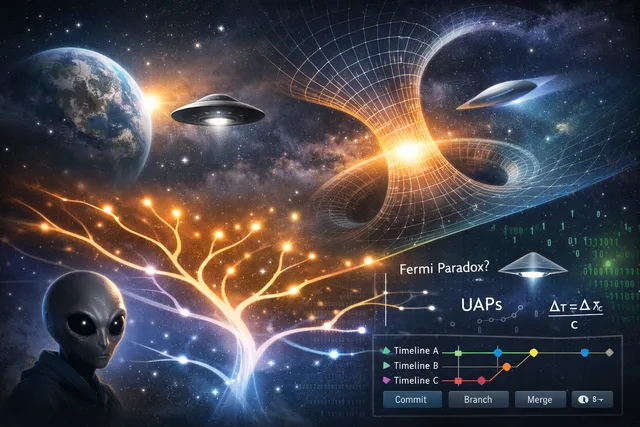
This article synthesizes concepts from theoretical physics and speculative hypotheses to explore the nature of potential extraterrestrial intelligence. It examines the Fermi Paradox, the characteristics of Unidentified Anomalous Phenomena (UAPs), and the implications of spacetime manipulation. By drawing a conceptual parallel with version control systems, it proposes a model of 'branching timelines' to understand possible alien motivations, ranging from non-interference to subtle probabilistic influence, while maintaining strict scientific discipline and distinguishing established theory from speculation.
Beyond Technology: The Physics of Interstellar Travel
Core Idea: An advanced civilization capable of interstellar visitation would likely possess a mastery of fundamental physics, particularly spacetime manipulation, rather than relying on conventional propulsion over vast cosmic distances.
Discussions of extraterrestrial visitation often focus on advanced propulsion technology. However, the sheer scale of the universe, where distances between galaxies are measured in millions of light-years, renders conventional travel impractical, even at near-light speeds. A civilization capable of traversing such distances would not merely be technologically superior; it would have a fundamentally deeper understanding of physics. This implies the ability to manipulate the fabric of spacetime itself. Theoretical concepts such as wormholes (Einstein-Rosen bridges) offer a hypothetical mechanism for such travel. A stable, traversable wormhole would act as a shortcut through spacetime, connecting two distant points. According to general relativity, manipulating spacetime to create such a shortcut would inherently involve the manipulation of time, a concept known as time dilation. Therefore, a civilization controlling wormholes would not just be space-faring but spacetime-faring, blurring the lines between travel, observation of the past, and the potential sampling of future outcomes.
Controversy Note: While wormholes are a valid solution to the equations of Einstein's general relativity, the existence of stable, traversable wormholes remains entirely hypothetical. They would require vast amounts of 'exotic matter' with negative energy density, which has never been observed and whose properties are not understood.
Citations in this section:
Morris, M. S., & Thorne, K. S. (1988). Wormholes in spacetime and their use for interstellar travel: A tool for teaching general relativity. American Journal of Physics, 56(5), pp. 395-412. https://doi.org/10.1119/1.15620
The Fermi Paradox and Its Principal Hypotheses
Core Idea: The statistical probability of extraterrestrial life, suggested by the vastness of the universe, starkly contrasts with the lack of observational evidence, a contradiction known as the Fermi Paradox. Several hypotheses attempt to resolve this.
The term 'alien' encompasses any life form not originating on Earth, from microbial organisms to complex intelligence. Given the hundreds of billions of galaxies, each containing billions of stars, the statistical argument for the existence of life elsewhere is compelling. The Drake Equation is a probabilistic framework used to estimate the number of active, communicative extraterrestrial civilizations in the Milky Way galaxy. While its variables are largely unknown, it formalizes the logic that even with conservative estimates, we should not be alone. This leads to the Fermi Paradox: If intelligent life is probable, why have we found no evidence of it? Several leading hypotheses address this silence:
1. The Great Filter: This hypothesis posits that there is at least one step in the development of a space-faring civilization that is so improbable that very few, if any, species ever overcome it. This 'filter' could be the emergence of life itself, the development of intelligence, or a self-destruction point (e.g., nuclear war, uncontrolled AI, climate collapse) that most intelligent species fail to survive.
2. Divergent Communication Methods: We primarily search for radio or laser signals. An advanced civilization may use communication methods based on physics we have not yet discovered (e.g., quantum entanglement, gravitational waves, or other phenomena), making their signals undetectable to us.
3. The Zoo Hypothesis (Non-Interference): This hypothesis suggests that advanced civilizations are aware of humanity but deliberately avoid contact to allow for our natural evolution and cultural development, similar to how zoologists observe animals in a nature preserve without interference. Earth may be a 'quarantined' or protected zone.
Controversy Note: The Fermi Paradox is a well-established problem in astrobiology, but all proposed solutions, including the Great Filter and Zoo Hypothesis, are speculative and lack empirical evidence. They are thought experiments based on our current understanding of science and history.
Citations in this section:
Hart, M. H. (1975). An explanation for the absence of extraterrestrials on Earth. Quarterly Journal of the Royal Astronomical Society, 16, pp. 128-135.
The Destructive Potential of Contact and the Rationale for Non-Interference
Core Idea: Historical precedents on Earth show that contact between civilizations with a significant power imbalance often leads to the collapse of the less advanced society, providing a strong rationale for a potential extraterrestrial policy of non-interference.
The Zoo Hypothesis is reinforced by analyzing human history. When technologically advanced civilizations have encountered less advanced societies, the outcome has frequently been catastrophic for the latter, even without overt hostility. The introduction of new technologies, belief systems, and economic structures can lead to the collapse of local traditions, languages, and social frameworks, creating dependency and identity crises. A truly advanced intelligence would likely understand this principle. Contact with a civilization millions of years ahead of us would not be a meeting of equals; it would be a reality-shattering event that could destabilize our entire global civilization, collapsing religious, political, and scientific institutions. Therefore, a highly ethical and intelligent civilization might adopt a strict non-interference policy, recognizing that the act of contact itself is a form of profound and potentially destructive intervention. Observation would be conducted from a distance, with any presence maintained in a state of ambiguity to avoid disrupting our natural developmental trajectory.
Controversy Note: This argument is an extrapolation based on human sociological and historical patterns. While logical, applying it to hypothetical alien psychology is speculative. There is no evidence to confirm that an alien intelligence would share or act upon this ethical reasoning.
Unidentified Anomalous Phenomena (UAPs) and Non-Newtonian Dynamics
Core Idea: Official reports of UAPs describe objects exhibiting flight characteristics, such as instantaneous acceleration and hypersonic speeds without signatures, that appear to violate known principles of physics and aerodynamics, suggesting a potential manipulation of inertia or spacetime.
Recent declassified reports from government and military sources describe Unidentified Anomalous Phenomena (UAPs) with consistent, extraordinary characteristics. Pilots and sensor data have documented objects that can hover silently, accelerate instantaneously to hypersonic speeds without any visible means of propulsion (no heat exhaust, no sonic booms), and execute right-angle turns that would produce G-forces fatal to a human pilot and destructive to any known aircraft. Observers note that these objects appear to move as if inertia does not apply to them. From the perspective of known physics, this is impossible for an object with mass. However, such behavior is consistent with theoretical concepts in general relativity, such as an Alcubierre drive, where spacetime itself is warped around an object, moving the 'bubble' of space rather than the object within it. While this remains highly theoretical, the observed kinematics of UAPs point away from conventional propulsion and toward a physics that manipulates spacetime directly. The critical point is not that these objects are confirmed as extraterrestrial, but that their reported behavior is inconsistent with our established understanding of aerodynamics and inertial physics.
Controversy Note: The U.S. government has officially acknowledged that these UAPs are real and not sensor errors, but their origin and nature remain unidentified. Extraterrestrial origin is one of many speculative possibilities, alongside secret human technology, natural phenomena not yet understood, or foreign adversary craft.
Citations in this section:
Office of the Director of National Intelligence (2021). Preliminary Assessment: Unidentified Aerial Phenomena. U.S. Government. https://www.dni.gov/files/ODNI/documents/assessments/UAP-Preliminary-Assessment-Report.pdf
Branching Timelines: A Conceptual Model for a Resilient Universe
Core Idea: The concept of branching timelines, analogous to a version control system like Git, offers a speculative model where the universe explores multiple potential outcomes, with unstable or catastrophic timelines being naturally 'pruned' to ensure systemic survival.
To understand how an advanced intelligence might interact with a developing world, we can explore a conceptual model of reality based on branching timelines, a notion related to the Many-Worlds Interpretation of quantum mechanics. A useful analogy is the Git version control system used in software development. In Git, a stable 'main branch' of code exists. To test a new feature, a developer creates a new 'branch'—a parallel version of the code. This branch can be experimented on without risking the stability of the main project. If the new code is successful and stable, it is 'merged' back into the main branch. If it fails or introduces critical bugs, the branch is discarded or 'pruned.'
Applying this as a metaphorical resemblance to cosmology, the universe could be seen as a system that explores multiple possible timelines (branches) at every quantum event. A single timeline universe would be incredibly fragile; one civilization's catastrophic mistake (e.g., a failed vacuum energy experiment) could destroy the entire system with no 'undo' button. A multiverse of branching timelines provides resilience. In this model, timelines that lead to systemic instability or large-scale destruction might naturally 'collapse' or become inaccessible, while more stable, sustainable timelines persist. This is not a conscious choice but a fundamental process of the system, where stability is the selection criterion for a timeline's continuation. The reality we experience would therefore be one that has proven to be a 'stable build' within the larger cosmic system.
Controversy Note: This is a philosophical and metaphorical model, not a scientific theory. It uses the logic of a man-made system (Git) to illustrate a speculative interpretation of the Many-Worlds Hypothesis. The idea that timelines are 'selected' for stability is a speculative layer added to the underlying physics framework, which itself is not universally accepted.
Citations in this section:
Everett, H. (1957). 'Relative state' formulation of quantum mechanics. Reviews of Modern Physics, 29(3), pp. 454-462. https://doi.org/10.1103/RevModPhys.29.454
The Nature of Interference: Probabilistic Influence vs. Direct Control
Core Idea: Within a branching timeline framework, 'interference' from an advanced intelligence would likely be subtle and probabilistic—influencing conditions to make certain outcomes more or less likely—rather than direct, overt intervention, which could create systemic instability.
If the universe operates on a system of branching timelines, then the nature of alien interference would be fundamentally different from direct control. An advanced civilization would understand that overt actions could create highly unstable timeline branches, risking both the observed civilization and potentially the wider system. Instead of forcing an outcome, they might engage in 'probabilistic biasing.' This involves introducing subtle inputs or adjusting initial conditions to shift the probabilities of various future paths. It is not about creating a specific timeline but about changing the 'selection pressure.' For example, they might subtly influence events to decrease the probability of a global nuclear war or an uncontrolled AI scenario. This form of intervention is minimal, indirect, and respects the free will of the developing civilization, as the outcome is never guaranteed. It is akin to a gardener weeding a patch to favor the growth of certain plants without genetically engineering the plants themselves. Any such influence would be kept below a threshold that would cause a major destabilization or reveal their presence unequivocally.
Controversy Note: This concept is entirely speculative and builds upon the unproven branching timeline model. There is no evidence for such probabilistic influence. It remains a philosophical exploration of what 'ethical' and 'intelligent' interference might look like under these hypothetical conditions.
Analyzing Potential Motivations: Protection, Containment, or Experimentation?
Core Idea: The motivations for a non-interfering, observational presence could range from protecting humanity from self-destruction, to assessing humanity as a potential threat, to conducting a long-term biological or sociological study.
Assuming an observational presence, several motivations can be hypothesized:
1. Protection: An advanced civilization may be acting as a steward, subtly protecting humanity from existential threats. This could include external threats like asteroid impacts or, more plausibly, internal ones. By observing countless civilizations, they may have identified patterns of self-destruction (the Great Filter) and are subtly nudging us away from the most catastrophic timelines.
2. Risk Assessment and Containment: Humanity's rapid technological growth, paired with its history of conflict, could be seen as a potential future threat to the cosmic neighborhood. The observation may be a form of risk assessment. If humanity is deemed too volatile, the 'Zoo' could be a form of quarantine, containing us until we reach a higher level of maturity.
3. Scientific Observation/Experimentation: Earth and its biosphere could be a unique and valuable subject of scientific study. Persistent anecdotal reports of 'alien abductions' share common patterns across cultures, such as missing time, medical examinations, and a focus on genetics and reproduction. While the dominant scientific explanation for these experiences involves psychological phenomena like sleep paralysis and false memory, the consistency of these narrative patterns has led to the speculative interpretation that they could represent a form of biological sampling or monitoring. In this context, 'abduction' is not kidnapping but data collection for a long-term study of a species' evolution, perhaps across multiple potential timelines.
Controversy Note: The 'alien abduction' phenomenon is not recognized as a physical reality by mainstream science. Explanations are rooted in psychology, neurology, and cultural factors. The interpretation of these anecdotal reports as evidence of a genetic sampling program is highly speculative and lacks empirical support.
Ancient Contact as Misinterpreted Science
Core Idea: References in ancient texts and myths to 'sky beings' or 'teachers from the stars' can be viewed not as proof of visitation, but as a philosophical similarity where encounters with advanced concepts or phenomena may have been misinterpreted and integrated into cultural narratives as mythology.
Numerous ancient cultures contain myths and religious texts describing powerful beings descending from the sky to provide knowledge, laws, or warnings. Examples include the 'Watchers' in apocryphal texts or the 'Vimanas' in Hindu scriptures. The 'ancient astronaut' hypothesis interprets these stories as literal records of extraterrestrial contact. However, a more epistemically disciplined approach is to view them as a metaphorical resemblance. If a limited, fragmented, or misunderstood contact did occur in the distant past, a pre-scientific society would lack the conceptual framework to understand it. Advanced science would be indistinguishable from magic, and technological beings would be interpreted as gods or angels. The information, stripped of its original context, would be absorbed into the prevailing belief system, transforming from observation into mythology. This perspective does not claim that aliens built ancient monuments, but rather considers the possibility that some foundational myths could be the cultural echoes of an event that was profoundly misunderstood.
Controversy Note: Mainstream archaeology, anthropology, and history do not support the ancient astronaut hypothesis. The prevailing scientific consensus is that ancient myths and structures are the products of human ingenuity, imagination, and cultural development, without any need for extraterrestrial intervention. Interpreting myths as historical records of alien contact is considered pseudoscience.
Conclusion
The question of extraterrestrial intelligence forces us to confront the limits of our own understanding. By moving beyond simplistic notions of alien invaders and embracing the implications of modern physics, we can construct more nuanced and logically coherent frameworks for speculation. The concepts of spacetime manipulation, the Fermi Paradox, and branching realities suggest that if an advanced intelligence is observing us, its presence would likely be subtle, its motives complex, and its methods geared towards preserving systemic stability rather than overt communication. While hypotheses like the Zoo Hypothesis or probabilistic interference remain firmly in the realm of speculation, they provide a valuable intellectual toolkit for contemplating our place in a universe that may be far more complex, and populated, than it appears. The ultimate goal is not to find definitive answers, but to ask better, more disciplined questions.
References
Everett, H. (1957). 'Relative state' formulation of quantum mechanics. Reviews of Modern Physics, 29(3), pp. 454-462. https://doi.org/10.1103/RevModPhys.29.454
Hart, M. H. (1975). An explanation for the absence of extraterrestrials on Earth. Quarterly Journal of the Royal Astronomical Society, 16, pp. 128-135.
Morris, M. S., & Thorne, K. S. (1988). Wormholes in spacetime and their use for interstellar travel: A tool for teaching general relativity. American Journal of Physics, 56(5), pp. 395-412. https://doi.org/10.1119/1.15620
Office of the Director of National Intelligence (2021). Preliminary Assessment: Unidentified Aerial Phenomena. U.S. Government. https://www.dni.gov/files/ODNI/documents/assessments/UAP-Preliminary-Assessment-Report.pdf
Key Questions
Join the Reality Circle to discuss this topic further.
Join the Circle to discuss